
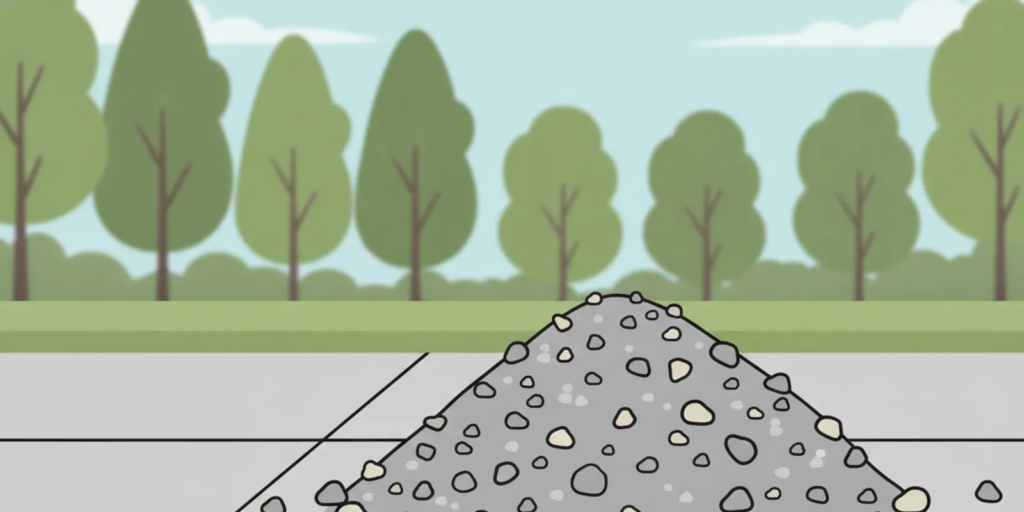
What is gravel? It is a broad term for loose, durable rock fragments used in construction, drainage, driveways, landscaping, and many other projects. The word does not identify one exact material: gravel can differ in source, stone shape, particle size, and the amount of fine material mixed in. Those details affect how it spreads, locks together, drains, and performs. For Minnesota buyers, the useful question is not only what gravel is, but which kind fits the job.
Call to discuss your gravel project
Published October 7, 2026
What does the word gravel mean?
Gravel is a category of aggregate made up of pieces of rock. In ordinary project conversations, people may use “gravel” to mean anything from rounded natural stone to angular crushed rock, or even a specified road-base blend. The name alone does not tell you the exact gradation or composition. Suppliers and project plans may describe a material by its grade, source, specification, or intended use instead.
Natural gravel is formed as rock is worn down and moved by water or other natural processes. Its particles are often rounded or partly rounded. Crushed gravel is produced by mechanically breaking larger rock into smaller pieces, which generally creates more angular faces. Some products are screened to separate sizes; others include a controlled blend of larger particles and fines. “Fines” means the small particles that fill spaces between larger stones.
These terms can overlap. A naturally sourced product may be screened or processed, while crushed aggregate can be sold in a range of blends. The product description and intended application matter more than assuming every load called gravel behaves alike.
How do gravel types differ in practical use?
For most projects, start by comparing four properties: particle shape, size range, fines content, and material composition. Together, they help predict whether the surface will compact, remain open for water to pass through, or look like decorative stone. The following table is a practical orientation, not a substitute for a project specification or supplier confirmation.
| Material characteristic | Typical behavior | Often considered for | Check before choosing |
|---|---|---|---|
| Angular crushed stone | Pieces can interlock when placed and compacted | Base layers, driveways, access routes | Specified grade, depth, compaction plan, and subgrade |
| Rounded natural gravel | Particles roll and shift more readily than angular pieces | Drainage, decorative areas, selected utility uses | Whether the application needs a stable compacted surface |
| Graded blend with fines | Smaller particles can fill voids and help a layer knit together | Road or driveway base and general site work | Whether the material meets the project or agency specification |
| Clean, open-graded stone | Fewer fines leave more open space between particles | Some drainage and bedding applications | Drainage design, containment, and required stone size |
Crushed limestone is one example of a crushed aggregate used in Minnesota. Minnesota Aggregates describes its Class 5 Gravel as MnDOT Spec 3138 crushed limestone for base construction. Class 5 is a named grade, not a synonym for every gravel product. Confirm the grade and its suitability when a plan, local authority, or contractor calls for a specific material. This guide to what Class 5 gravel is provides more detail on that particular product, while the Class 2 versus Class 5 comparison helps frame a grade-selection conversation.
Material selection for a base is not simply a matter of choosing the smallest or hardest-looking stone. A MnDOT-supported research project examined base type and thickness using uncrushed gravel, limestone, and dolomite, illustrating that material type and layer design are considered together in road applications. The study is specific to its evaluated road-base context, so use the project specification rather than applying a research result as a universal rule. (MnDOT research on base type and thickness.)
Which gravel works for different projects?
Driveways and access routes
A driveway needs a surface that suits the ground beneath it, the expected traffic, and how water moves across the site. A compactable crushed blend is commonly considered for a stable base because angular pieces can interlock and fines can fill gaps. The appropriate product and layer thickness depend on the site and design. A thin layer of decorative or rounded stone may shift under tires if it is asked to function as a structural base.
For a driveway, identify whether you are building a new section, repairing a soft spot, or topping up an existing surface. Those are not identical jobs. A new build may need subgrade preparation and several material layers; a refresh may require removing or reshaping loose material first. See the practical discussion of gravel options for driveways and the separate Class 5 driveway depth and preparation guide.
Road and parking-pad bases
Roads and parking pads face repeated loads. The base must be selected in context with the subgrade, drainage, traffic, and construction method. A gravel road study indexed by the Transportation Research Board evaluated the life-cycle cost of surfacing for an upgraded gravel road in Minnesota. It is a useful reminder that a road surface choice has maintenance and life-cycle considerations, not just an initial material decision; the study is not a one-size-fits-all specification. (Minnesota gravel-road surfacing study.)
If you are planning a parking pad or road base, consider how water will leave the area and whether the material can be placed and compacted in a controlled way. The step-by-step gravel road-base guide covers the broader installation process. For an individual home parking area, the Minnesota gravel parking-pad guide addresses project planning beyond the material name.
Drainage and utility work
Drainage applications often require stone that lets water move through connected voids. A blend with many fines may behave differently from clean, open-graded stone. That does not mean the cleanest or coarsest gravel is automatically the right choice: pipe bedding, drainage trenches, and surface drainage each have distinct design requirements. Match the stone to the system details, including pipe, fabric, trench dimensions, and outlet.
For water management at the surface, the ground slope and outlet matter as much as the aggregate. Gravel cannot correct a drainage problem if water has nowhere to go. If the work also involves reshaping the surrounding grade, review gravel driveway drainage approaches and what land grading is meant to accomplish.
Landscaping and decorative areas
In garden paths, borders, or other decorative areas, appearance and ease of upkeep may matter more than structural strength. Color, consistency, particle shape, and how the surface feels underfoot can guide the choice. A stone that looks right in a sample can still migrate if edging is missing or the base is poorly prepared. Consider how the area will be used, whether plants or paving meet the gravel, and how you will keep material in place.
For planted areas, avoid assuming that gravel itself improves soil or replaces a designed growing medium. Separate the decorative surface from the soil and drainage needs beneath it. For ground-covering and garden work, check whether topsoil is also needed; Minnesota Aggregates offers black dirt delivery information for landscaping projects.
What should Minnesota buyers consider before ordering?
Before requesting a quote, describe the finished job rather than asking only for “a load of gravel.” The more precisely you define the area, grade, and access, the easier it is to discuss a suitable material and delivery plan. For a first estimate of volume, use the cubic yardage calculator; then confirm the appropriate quantity and product with the supplier or project professional.
- State the application. Say whether the material is for a driveway base, a road repair, drainage, a path, or another purpose. Include whether it is a new installation, a repair, or a top-up.
- Identify any specification. If a contractor, engineer, local authority, or plan names a class, gradation, or specification, share that exact wording. Do not substitute a generic gravel description for a specified product without approval.
- Measure the area and depth. Record length and width, plus the planned depth. If the site is irregular, divide it into simpler shapes and estimate each separately. A cubic-yard calculation is a planning estimate; actual quantities can change with grading, compaction, and site conditions.
- Describe the ground and water conditions. Mention soft areas, existing pavement or gravel, slopes, and where runoff goes. These details can affect preparation and what the project needs beneath the visible surface.
- Explain delivery access. Note the unloading location, turning room, overhead wires or branches, gates, soft ground, and obstacles. A truck needs a safe route and a practical place to unload. Ask whether your requested drop point can be reached by the available truck.
- Plan timing and placement. Have the area ready before the load arrives, and consider who will spread and compact the material. Minnesota Aggregates lists general material delivery as typically 3–4 business days; confirm the current schedule, product, and site conditions when requesting a quote.
Delivery logistics are part of the material decision. A product can be appropriate on paper but difficult to place if the truck cannot reach the intended area or the site is not ready. If you need help with spreading, grading, or site preparation, review the available skid steer services and explain the scope when asking about the project.
How do you estimate the amount of gravel?
Start with the area to cover and the planned depth. Convert the depth to feet, then multiply length × width × depth to get cubic feet. Divide by 27 to convert cubic feet to cubic yards. For example, an area 20 feet long and 10 feet wide at a planned depth of 0.25 feet has a simple geometric volume of about 50 cubic feet, or roughly 1.85 cubic yards before allowing for site variation or compaction.
This calculation estimates space, not a guaranteed delivered weight or finished result. Gravel products differ in density, and a sloped or uneven site may require more material than a simple rectangle suggests. Do not add an arbitrary extra percentage if the project has a formal specification; ask the contractor or supplier how quantity should be calculated for the particular material and installation. The gravel quantity guide explains measurement and ordering considerations in more detail.
How do Minnesota site conditions affect gravel work?
Weather and soil conditions influence how a gravel project should be timed and prepared. Freeze-thaw cycles can expose weak spots, while spring moisture may leave some unpaved areas soft or difficult for equipment to cross. A material that performs well on a firm, prepared base may not solve a problem caused by saturated soil or poor drainage. Assess the ground before placing a new layer, and avoid treating fresh gravel as a shortcut around needed grading or drainage work.
Plan the delivery for a time when the truck can reach the drop area and the crew can place the material safely. If the site is wet, steep, or narrow, describe those conditions when asking about delivery access. For larger or more technical projects, follow the project engineer’s or contractor’s seasonal and compaction guidance; local conditions can vary from one property to another. Minnesota-specific decisions about a road or driveway should account for the actual use, soil, water flow, and maintenance plan rather than relying on a generic rule of thumb.
What mistakes should you avoid?
- Choosing by name alone. “Gravel” can refer to different shapes and blends. Ask for the product grade and intended use.
- Using a surface material as a base by default. Decorative stone and structural base material have different jobs. Confirm the design for the layer beneath the surface.
- Ignoring water. A material choice does not replace slope, drainage, and outlet planning.
- Ordering from an unverified measurement. Measure the area and depth, then check whether the estimate accounts for grade changes and compaction.
- Overlooking unloading access. Tell the supplier about site constraints before scheduling rather than discovering them when the truck arrives.
- Assuming all specifications are interchangeable. If an agency or project plan calls for a named grade, verify that the supplied product meets it.
Ready to choose gravel for your project?
Use “gravel” as the starting category, then narrow the choice by application, grade, particle shape, fines, and site conditions. When a project requires a specified material, follow the project documents and confirm the exact product before ordering. For a residential improvement, clear measurements and an honest description of access and drainage make the conversation more useful.
Request a gravel delivery quote
Frequently asked questions
Is gravel the same as crushed stone?
Not always. Gravel is a broad everyday term for rock fragments, including natural rounded material and processed crushed products. Crushed stone specifically describes rock mechanically broken into pieces; the exact product still depends on its size range and blend.
Does gravel always compact?
No. Compaction depends on particle shape, gradation, fines, moisture, placement, and the underlying ground. A graded blend with angular particles may knit together differently from clean, rounded stone. Ask which material is intended for the layer and follow the appropriate installation method.
Can I use one gravel product for every part of a driveway?
Not necessarily. A driveway may need a prepared subgrade, a base, and a wearing surface, each with different performance needs. Use the project design or get guidance on the full layer assembly rather than assuming a single product works everywhere.
How do I know if my project needs a specified grade?
Check the plans, contract, or instructions from the contractor or local authority. If any document names a class or specification, share it when requesting material. For informal residential work, explain the application and site conditions and ask the supplier to confirm an appropriate option.
Sources
For further technical context, see the MnDOT research report on base type and thickness and the Transportation Research Board-indexed study of Minnesota gravel-road surfacing costs. These references address specific road and base contexts; project specifications should govern material selection.