
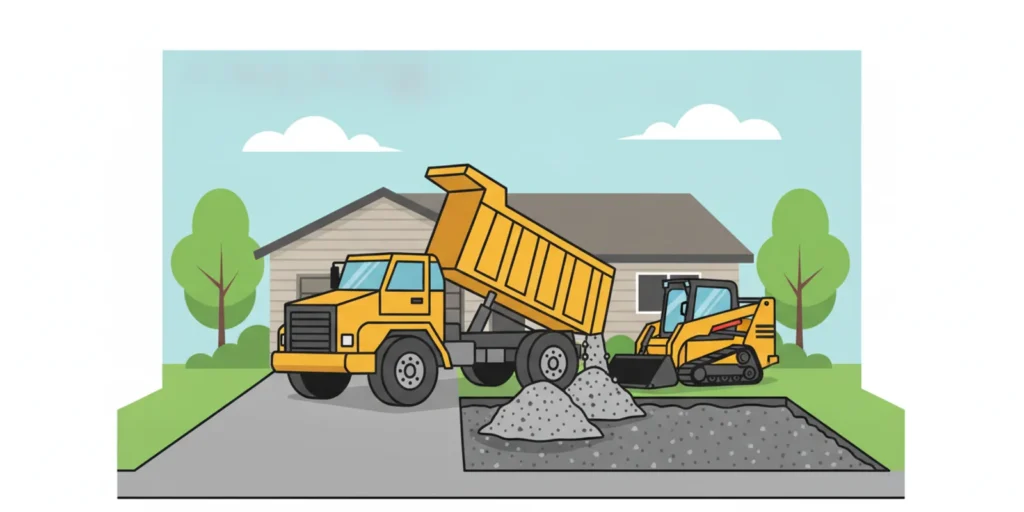
Planning a recycled concrete driveway means more than multiplying length by width. The recycled concrete driveway cost depends on the material quantity, delivery distance, site access, and how much preparation or equipment work the project needs. Since those details differ from one property to another, a useful quote starts with a clear scope rather than a generic price per square foot.
Request a project-specific quote
What does a recycled concrete driveway quote include?
A quote may cover aggregate, delivery, and selected equipment services, but you should confirm each item. Some proposals price material delivery only. Others may also include spreading or grading. Removal of an old surface, excavation, drainage work, and compaction may be separate tasks or handled by another contractor. Do not assume a low material figure represents the total installed project cost.
Ask the supplier to describe the material being quoted, the estimated amount, the delivery arrangement, and any work included. If you are still checking what recycled aggregate products mean, review this overview of recycled Class 5 as background; confirm that the specific product offered matches the driveway design and intended use. Product composition and suitable applications should be verified with the supplier and project professional, not inferred from a broad category name.
Research on construction-industry recycling economics also illustrates why material and processing costs should not be treated as interchangeable: the cited paper discusses labor as one factor in the economics of recycled construction materials. Its example is not a local driveway estimate or a recycled-concrete price list, so use it only as context for why quotes need a defined scope: The economics of recycling in the US construction industry.
Which factors change the quote most?
Driveway area and shape
Area is the starting point for estimating how much aggregate a project may require. Measure the driveway in sections instead of guessing from the street. For a rectangle, multiply length by width. For an L-shaped or curved layout, divide it into rectangles and triangles, estimate each section, then add the areas. Include parking aprons, widened entrances, turnarounds, or a separate parking bay if they are part of the work.
A sketch with measurements is often more useful than a single approximate total. Label each section and note where the surface changes width. If the driveway narrows near the house or flares at the road, those differences affect volume. The cubic yardage calculator can help turn dimensions into a preliminary quantity for discussion.
Depth and design requirements
Depth changes the volume directly: a deeper layer across the same footprint requires more material. But choosing a thinner layer just to reduce the quote can undermine the design. Required depth depends on the subgrade, drainage, anticipated use, and whether the project calls for one layer or a constructed base. Use a depth supplied by the project design or confirm it with a qualified contractor familiar with the site.
Keep the depth assumption consistent while comparing proposals. One quote based on a thin topping layer cannot be compared fairly with another that assumes excavation and a deeper base. Ask whether the quoted depth is the loose placement depth or a target finished layer, and who is responsible for confirming the final design and quantity. Do not treat a volume calculator as a substitute for those decisions.
Quantity, ordering, and delivery plan
For a simple rectangular section, estimate volume in cubic yards with this formula:
Length (feet) × width (feet) × depth (feet) ÷ 27 = approximate cubic yards.
For example, a 40-foot by 12-foot section with a planned 4-inch layer has a depth of 4 ÷ 12, or about 0.333 feet. The calculation is 40 × 12 × 0.333 ÷ 27, which is about 5.9 cubic yards before any project-specific adjustments. This is a planning estimate, not a guaranteed delivered quantity. Irregular edges, subgrade correction, placement and compaction methods, and the supplier’s measurement basis can affect the order.
Ask how the supplier expresses quantity and whether the proposal is based on cubic yards, tons, or another basis. Do not convert between units using a guessed density; material moisture and composition can change the relationship. A helpful quote discussion confirms the dimensions, chosen depth, quantity basis, and any allowance for site conditions before scheduling.
Distance, access, and unloading location
Delivery distance and route affect the delivery plan. Provide the full project address rather than a general area. Also describe the approach: narrow entrances, sharp turns, low branches or wires, soft shoulders, steep slopes, overhead obstructions, and limited room to turn around can all affect where a truck can safely travel or unload.
State where you want the material placed and whether the truck can reach that spot. A driveway may be long enough for a vehicle to enter but still have no safe turning area or room to unload. If the drop point is near a garage, fence, sidewalk, or landscaping, mention it in advance. Photos of the entrance and placement area can help clarify constraints, but they do not replace an on-site assessment when one is needed.
Existing condition and preparation
The current driveway can change the amount of work needed before new aggregate arrives. A surface with a stable base and suitable shape may require a different plan from one with deep ruts, soft spots, standing water, buried debris, or failed edges. Clarify whether old material must be removed, whether excavation is planned, and who will arrange that work.
Drainage and finished elevation deserve attention before adding material. The driveway should direct water appropriately and avoid shifting runoff toward a building, road, or neighboring property. The slope and drainage approach depend on the site. Use this driveway drainage planning guide to identify questions to raise, not as a substitute for a site-specific design. Changes in elevation can also affect how much material is needed at low or uneven areas.
Spreading, grading, and compaction
Delivery is not the same as installation. If material is tipped in a pile, someone still needs to distribute it and shape the surface. Ask whether spreading or grading is included, and what the description means in practice: placing a new layer, reshaping existing aggregate, correcting low areas, or some combination. Minnesota Aggregates lists skid steer services for grading and site preparation; confirm the availability and scope for your particular project.
Compaction should also be assigned clearly. The right equipment and sequence depend on the design, material, moisture conditions, and base. Ask who will compact the layer, whether that work is included, and what preparation is expected before the equipment arrives. Do not assume that a truck delivery includes spreading or that a single equipment pass meets every project requirement.
How do the main quote factors compare?
| Factor | Details to provide | Why it affects the quote |
|---|---|---|
| Area and shape | Measurements for each section, including flares and parking areas | Establishes the footprint to cover |
| Depth and design | Specified layer depth, design notes, and intended use | Changes volume and the scope of base work |
| Quantity basis | Estimated volume and whether the quote uses yards or tons | Prevents mismatched assumptions or guessed conversions |
| Delivery | Full address, preferred timing, and unloading point | Distance and logistics shape the delivery plan |
| Access | Entrance width, overhead clearance, turns, and ground condition | May limit truck access or placement choices |
| Preparation | Ruts, soft areas, drainage, old material, and excavation needs | Identifies work beyond supplying aggregate |
| Finish work | Spreading, grading, and compaction requested | Separates delivery-only pricing from installed work |
How can you prepare for an accurate quote?
- Measure each section. Record length and width, sketch curves or flares, and include any apron or turnaround in the scope.
- Confirm the intended depth. Use the project specification if available. If it is not, ask the person responsible for the driveway design to advise before comparing quantities.
- Describe the existing surface. Note standing water, soft spots, ruts, steep areas, old aggregate, and any material that may need removal.
- Explain truck access. Send the address, describe the route and obstacles, and identify the preferred location for unloading.
- List the work you want priced. State whether you need delivery only or want spreading, grading, preparation, or compaction included.
- Share timing requirements. Say when you hope to receive the material and whether the date is flexible. Seasonal scheduling and route availability can affect the delivery plan.
- Ask for assumptions in writing. Request the quoted product, quantity basis, delivery scope, included services, and any unresolved site questions.
For a first-pass estimate, a square or rectangle calculation is useful. For instance, if the driveway consists of a 40-by-12-foot main lane plus a 10-by-10-foot parking section, calculate each section separately before combining them. Apply the same specified depth to both only if the design calls for it. If the apron needs a different build-up, keep it separate in the estimate rather than hiding the difference inside one rough total.
When a project includes a base layer, compare the design and material specification rather than assuming all aggregate terms mean the same thing. The company’s Class 5 delivery information and this Class 1 versus Class 5 guide can help you prepare questions about base materials; neither determines whether a recycled concrete product is right for a particular design.
How can you keep the project scope from changing?
Before scheduling, walk the driveway and compare the real site with the description used for the quote. Mark the intended edges, note any soft or low areas, and identify where water currently moves after rain. If the scope assumed a firm surface but inspection reveals a failed section, pause and clarify whether that area needs separate work. Resolving the difference before the truck arrives is easier than making a rushed decision while material is being delivered.
Confirm that the unloading area will be clear and that the planned truck route is usable on the delivery date. Move vehicles and stored items, keep people and pets away from the work zone, and address any access restriction you mentioned when requesting the quote. These practical steps do not change the material quantity, but they reduce confusion about where the load can go and whether the original placement plan is still workable.
Also separate the driveway into project phases if the full work will not happen at once. For example, a homeowner may first arrange removal or subgrade repair, then schedule aggregate delivery, followed by spreading and final shaping. Confirm whether the material will be delivered in one load or in a sequence suited to the site. Do not assume that changing the sequence or unloading location has no effect; ask the supplier to confirm the plan and any revised scope.
How should you compare quotes without guessing at prices?
Compare like with like. A material-only quote and a proposal that includes delivery, spreading, or grading have different scopes even if one headline figure looks lower. Put each proposal beside the same driveway dimensions, depth, product description, quantity basis, delivery location, and preparation assumptions. If any one of those changes, the comparison changes too.
Consider two hypothetical proposals. Proposal A covers aggregate delivery to an accessible drop point and leaves spreading to the owner. Proposal B includes delivery and equipment time to distribute and shape the material, but excludes removal of a soft or failed section. The proposals cannot be ranked by the material figure alone. Ask what work remains after each option, who will do it, and whether the assumed site condition matches the driveway.
For material-selection questions beyond pricing, consult the driveway aggregate planning guide and gravel size chart. If the property has a pronounced slope, the steep driveway solutions guide can help identify design questions to discuss. These resources are general planning information; they do not supply a project-specific price or design approval.
What should you ask before ordering?
- Which specific aggregate product is included, and is it suitable for the planned driveway design?
- What dimensions, depth, and quantity basis were used to prepare the quote?
- Is delivery included, and where can the truck unload?
- Are spreading, grading, site preparation, and compaction included or separate?
- Who is responsible for drainage planning, excavation, and removal of existing material?
- What access or ground conditions could change the delivery plan?
- What delivery window is available, and what details need confirmation before scheduling?
For broader quantity planning, this guide to estimating gravel quantity offers another reference point. If you are comparing driveway surfaces, use the natural rock driveway guide for additional planning context, while keeping the requested material and work scope consistent in each quote.
Send your measurements and request a quote
Frequently asked questions
Can I estimate recycled concrete driveway cost by square foot?
Square footage describes the surface area but not the full project scope. Depth is needed to estimate volume, while delivery distance, access, site preparation, and equipment work can also affect the quote. Treat an area-based number as an early planning aid, not a final project price.
Does a material delivery quote include spreading?
Not necessarily. Ask whether the price covers delivery only or also includes spreading and grading. Confirm who will compact the material and whether preparation or removal is excluded.
What should I send when asking for pricing?
Share the property address, measurements, planned depth if known, current surface condition, access details, preferred unloading location, and the work you want included. Photos can help explain an entrance or placement issue.
Is recycled concrete suitable for every driveway?
No single material suits every site. The right choice depends on the design, subgrade, drainage, intended use, and applicable requirements. Confirm the product and depth with the supplier and project professional before ordering.
Final planning note
A dependable driveway quote begins with a defined footprint, a defensible depth, clear delivery details, and an honest description of the existing site. Gather those details first, then compare proposals by the complete scope of work rather than one isolated number.