
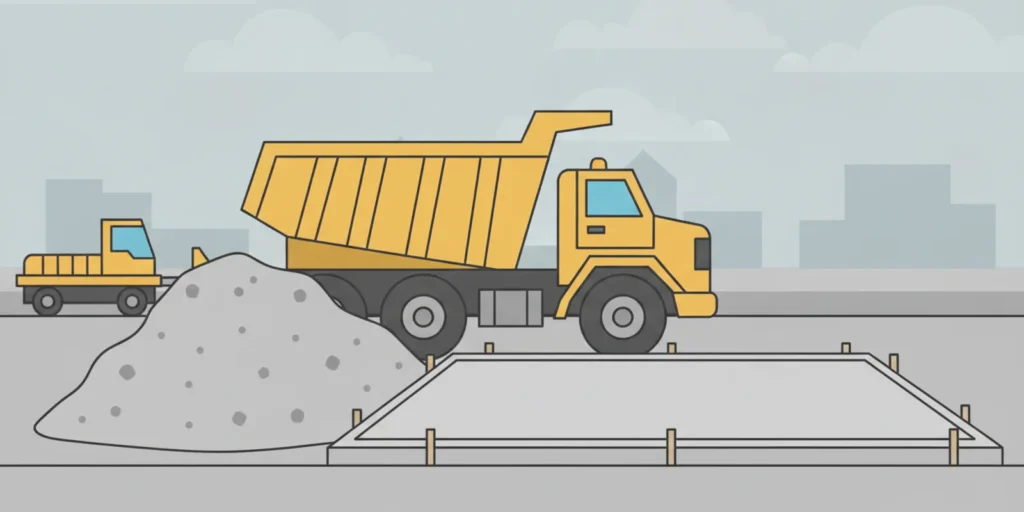
Recycled aggregate for concrete can mean two different things: recycled material used beneath or around concrete work, or recycled aggregate included directly in a new concrete mix. Those are separate applications with separate requirements. For many property and construction projects, recycled material may be worth discussing for access, subbase, or site preparation, but the concrete professional and project specifications must determine whether it is appropriate.
Call Minnesota Aggregates to discuss your material and delivery needs
Published: October 2, 2026
What does recycled aggregate for concrete mean?
Aggregate is granular material such as crushed stone, gravel, or sand. Recycled aggregate is produced by processing previously used material, often concrete from demolished structures or pavement. Its size and composition depend on the original material and how it was processed. The label alone does not tell you whether it meets a particular project specification.
In conversations about a concrete project, “recycled aggregate” may refer to material placed under a concrete feature, such as a slab or pavement section, or aggregate incorporated into the concrete mix itself. The first is a supporting layer or construction material outside the concrete. The second becomes an ingredient in the concrete. Do not assume approval for one use means approval for the other.
Recycling concrete can keep useful material in circulation, but the project still needs the right material in the right location. The U.S. Environmental Protection Agency discusses construction and demolition material recovery as part of its sustainable management of construction and demolition materials. That general resource is useful context; it does not approve a specific load or establish that a material meets your plans.
How is base aggregate different from aggregate in a concrete mix?
A base layer is placed below a concrete surface. Depending on the design and site, the layer can support construction access, provide a prepared working surface, or form part of the planned foundation assembly. The project designer specifies its material, depth, grading, compaction, and drainage details. A recycled concrete base material is not the same thing as concrete, and it does not automatically replace every specified base product.
Aggregate in a concrete mix is one of the ingredients combined with cementitious material, water, and sometimes admixtures. Mix requirements can depend on the intended application, exposure, strength design, placement, and applicable specifications. Recycled material used in a mix must be evaluated under those requirements by the concrete producer or responsible professional. A material suitable as fill or subbase is not thereby suitable as a mix ingredient.
The Federal Highway Administration’s pavement recycling resources discuss recycling in roadway contexts. They provide background on reuse in pavement work, not blanket approval for residential slabs, foundations, structural concrete, or any particular mix. Always follow the project documents and have the responsible professional resolve questions about material acceptance.
Where might recycled material fit around a concrete project?
Potential uses are project-specific. Recycled aggregate may be considered for a temporary construction access route, a non-structural fill application, or a designed layer beneath pavement when the specifications permit it. It may also be used in site preparation away from the concrete itself. The key is to identify the exact layer and function rather than asking only whether a material is “good for concrete.”
- Access during construction: A suitable granular material can help create a working route or staging surface. Site traffic, turning, drainage, and the desired service period affect what is appropriate.
- Subbase below a planned surface: The plans may allow a particular recycled product, or they may call for a named material and gradation. Confirm the specification before placing it.
- General site preparation: Material may be considered for filling or shaping areas that are not part of a designed concrete assembly, subject to site conditions and any applicable requirements.
- Concrete mix ingredient: This is a distinct, controlled use. The concrete producer or engineer must confirm whether the source and properties are allowed for the intended mix.
For comparison, Minnesota Aggregates describes its Class 5 gravel delivery as a material option for base-related projects. Its business information identifies Class 5 as MnDOT Spec 3138 crushed limestone; that does not mean it is recycled concrete aggregate. Review the required product and ask questions before treating any two materials as interchangeable.
When should you avoid assuming recycled aggregate is suitable?
Do not substitute recycled material for a specified product without approval. This matters especially when plans identify a particular gradation, source type, strength-related requirement, or testing procedure. A product name or supplier description cannot override the project documents. Ask the engineer, concrete contractor, or other responsible professional before ordering if the intended use is part of a permitted, engineered, or structural project.
Also avoid assuming that all recycled material is uniform. Processing and source materials can vary. Depending on the product and application, the buyer may need to confirm particle-size distribution, fines, foreign material, cleanliness, moisture, or other acceptance criteria. A supplier can explain available product information, but the project professional should interpret it against the applicable specification.
For material that will be batched into concrete, the concrete supplier needs to evaluate it as a mix component. Ask what documentation, testing, or approval is required before any delivery. Do not put unverified recycled material into a concrete mix based only on appearance, a general claim that it is “clean,” or its use elsewhere on the site.
What should you compare before choosing a base material?
Start with the function, then compare the options that the plans or responsible contractor will accept. Recycled concrete aggregate, conventional crushed aggregate, and other granular materials may differ in composition, gradation, handling, availability, and suitability. The comparison below is a planning aid, not a design specification.
| Material or use | Where it may fit | What to verify first |
|---|---|---|
| Recycled concrete aggregate as a base or subbase | Potentially a specified layer under a paved or concrete surface, or another approved site application | Whether the plans allow recycled material; required gradation, placement, compaction, drainage, testing, and source documentation |
| Conventional crushed aggregate base | A specified base course or prepared area when the named material is required | Exact product and gradation, layer depth, compaction method, site drainage, and delivery access |
| Aggregate used in a concrete mix | Ingredient batched into fresh concrete | Concrete producer and project professional approval, mix requirements, applicable standards, and material testing |
| General fill or temporary access material | Non-structural site preparation or construction access, if acceptable for the site | Load, ground conditions, drainage, final use, and whether the area later becomes part of the designed assembly |
For more context on conventional base products, see this guide to Class 2 vs. Class 5 gravel and the overview of what Class 5 gravel is. These guides can help you frame product questions, but the project specification remains the deciding reference.
How do you evaluate a recycled aggregate source?
Ask clear questions before scheduling a load. The answers help you determine whether the source can be considered for the proposed role and what information your contractor needs. They do not replace professional approval.
- Name the exact application. Say whether you need temporary access, a subbase, general fill, or an ingredient for a concrete mix. Avoid the broad description “for concrete” when you mean a particular layer.
- Share the plans or material specification. Provide the product name, required gradation, depth, testing criteria, and any restrictions on recycled sources. If there is no written specification, ask the contractor or designer to clarify the required performance.
- Ask about material composition and processing. Find out what the recycled product is made from and what sizing or screening information is available. Ask whether the supplier can provide documentation your project professional requires.
- Confirm acceptance with the responsible professional. The engineer, concrete producer, inspector, or contractor responsible for the work should confirm in writing when the project calls for approval.
- Plan quantity and placement. Measure the area and planned depth, allow for the project’s compaction and handling needs, and agree on how the material will be placed. Use a cubic yardage calculator as an estimating aid, then verify the order quantity with the supplier and installer.
- Review delivery access. Consider truck approach, overhead clearance, ground conditions, turning space, unloading location, and whether the site will be ready when material arrives.
How do you estimate the amount without guessing?
Estimate the area and planned depth only after confirming the design. For a simple rectangular area, multiply length by width by the depth expressed in feet to get cubic feet, then divide by 27 for cubic yards. As an illustration, a 10-by-20-foot area with a planned 4-inch layer is about 2.5 cubic yards by geometric volume before any allowance for site conditions or placement. That arithmetic does not decide the required layer depth or final order quantity.
Actual ordering can depend on the material, how it is measured or sold, the shape of the site, the condition of the subgrade, and whether the design calls for compaction. Avoid adding a made-up compaction factor. Ask the installer or supplier how to translate the approved dimensions into an order quantity, and confirm whether the quoted unit is cubic yards, tons, or another measure. If the area is irregular, break it into simple shapes and add their volumes, or use a calculator as a first estimate.
Before delivery, compare the estimated amount with truck capacity, unload location, and the sequence of work. A quantity that is correct on paper may not be practical if the site cannot accept the load or the receiving area is not ready. For a more exact number, provide measurements and the approved material details when requesting guidance.
When a project includes both material delivery and spreading or grading, ask whether the work can be coordinated. Minnesota Aggregates offers skid steer services for grading and site preparation; confirm the specific scope, site conditions, and material requirements before assuming a service is suitable for your job.
What Minnesota site conditions should you plan for?
In Minnesota, weather and seasonal ground conditions can affect when a site is ready, how trucks reach it, and whether a prepared area will remain stable during construction. Thaw, rain, or soft ground can change access and placement conditions. Plan the delivery around the actual site, not only the calendar, and coordinate timing with the contractor responsible for preparing the area.
Concrete work also depends on more than the aggregate beneath it. Site drainage, subgrade conditions, elevations, the specified base, and the concrete placement plan all interact. If the base is being installed before a pour, coordinate its final elevation and compaction with the concrete contractor. Do not use a delivery estimate or a general material guide to set engineering details.
For a driveway or access area, the right material and construction sequence depend on its intended traffic and the design. Minnesota Aggregates has additional information about installing a gravel road base and driveway drainage considerations. Those topics help with general planning, but a concrete slab, pavement section, or engineered project may have different requirements.
How can you coordinate aggregate with the concrete schedule?
Material selection is only one part of a successful concrete project. The sequence matters too. A clear handoff between the designer, site contractor, concrete provider, and material supplier helps prevent a load from arriving before the area is ready or a base from being installed to the wrong elevation.
- Confirm the intended design first. Identify the layer where the material will go and what the plans require. If the design is not complete, do not order recycled aggregate on the assumption it will be approved later.
- Get the source accepted. Send the product information to the person responsible for approval. Confirm any required documentation or testing before scheduling delivery, especially when the material is part of a specified base or concrete mix.
- Prepare the route and drop area. Make sure the truck can reach the location and unload without crossing an area that should remain undisturbed. Mark underground utilities and communicate obstacles or soft ground to the contractor and supplier.
- Coordinate elevation and compaction. Agree who will spread and compact the material, what finished elevation is needed, and how the concrete crew will verify the prepared surface. For a detailed material-spreading job, review the site’s gravel spreading considerations with the installer; the method for your project should still follow its plans.
- Recheck conditions near delivery. Rain, thaw, and active site work can change access or placement conditions. Confirm that the site is ready and the unloading point is still safe before the truck is dispatched.
For example, a homeowner preparing a small pad should first ask the contractor whether the project has a specified base material and depth. A commercial crew preparing a larger paved area may also need documented gradation or testing. In either case, the volume, truck access, and installation plan should be settled only after the required material is clear.
A delivery conversation can help surface practical constraints, such as access, quantity, or desired timing. It cannot replace the plan review or approval required for a designed concrete assembly. Keep the material description and intended use consistent across the contractor, supplier, and concrete provider so everyone is discussing the same product and location.
What questions should you ask before ordering?
- What exact layer or function is this material intended to serve?
- Do the project plans allow recycled aggregate from this type of source?
- What gradation, cleanliness, testing, or documentation does the project require?
- Who has authority to approve the product: the engineer, contractor, inspector, or concrete producer?
- How much material is needed after accounting for area, depth, and placement conditions?
- Can the delivery truck reach and unload safely at the planned location?
- Is the delivery window compatible with site preparation and concrete scheduling?
For general material planning, Minnesota Aggregates also has a gravel size chart and information about common aggregate materials in Minnesota. Use them to prepare questions, not to substitute one product for another without checking the specification.
Contact Minnesota Aggregates to discuss delivery and site details
Frequently asked questions
Can recycled concrete aggregate go under a concrete slab?
It may be considered when the design and project specifications allow that source and the material meets the stated requirements. Ask the engineer or concrete contractor to approve the product, layer, and placement details before ordering.
Can recycled aggregate be used in a new concrete mix?
That is different from using recycled material as a base. The concrete producer and responsible project professional must determine whether a specific recycled source meets the mix requirements and applicable specifications. Do not assume general acceptance based on use in another project.
Is Class 5 gravel recycled concrete aggregate?
Not based on the product description provided by Minnesota Aggregates. The company identifies its Class 5 as MnDOT Spec 3138 crushed limestone. Confirm the exact material source and specification with the supplier rather than treating “Class 5” and “recycled concrete aggregate” as synonyms.
Who decides whether a recycled material is acceptable?
The project documents and the professional responsible for the work determine what is acceptable. Depending on the project, that may involve the engineer, concrete producer, contractor, or inspector. The supplier can provide product information, but should not replace project-specific approval.
Sources
- U.S. Environmental Protection Agency: Sustainable Management of Construction and Demolition Materials
- Federal Highway Administration: Pavement Recycling Resources
Recycled aggregate can be a useful material to evaluate, but its role must be clear: a base material and a concrete-mix ingredient are not interchangeable, and project requirements should guide the decision.