
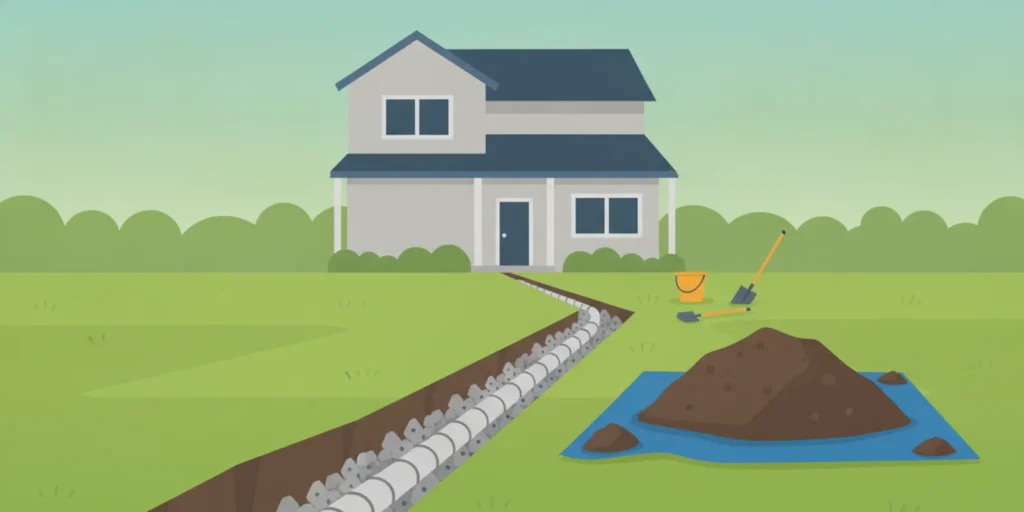
Choosing gravel for a French drain is about more than filling a trench. The stone needs to leave open spaces for water to move, work with the pipe and any fabric in the system, and suit the soil and drainage plan at your property. Before ordering, confirm the material size and type, the trench dimensions, and where the water will go. Those decisions help prevent a load that is difficult to place or does not fit the design.
Call to discuss your aggregate needs
What does gravel do in a French drain?
A French drain is a water-collection and conveyance system, not simply a gravel-filled ditch. In a common residential setup, water moves through permeable ground and the voids between stones toward a perforated pipe, then travels along the pipe to a suitable outlet. The stone creates a permeable zone around the pipe and helps keep surrounding soil from immediately filling the pipe openings.
Every part has a role: trench shape and grade direct water, stone creates open pathways, pipe carries collected water, and fabric may separate the drainage zone from soil. A weakness in one part can limit the whole system. For example, a large volume of stone cannot compensate for a pipe with no workable outlet or a trench that does not lead water where it needs to go.
French drain designs vary by soil, water source, site slope, and local requirements. A perimeter drain beside a foundation, a shallow yard drain, and a long drainage run may call for different details. Treat online dimensions as planning references, not a substitute for evaluating your site. If the water problem is close to a foundation or affects neighboring property, consult a qualified drainage professional before digging.
What kind of stone is used around the pipe?
Drainage systems generally need stone that leaves connected voids for water to pass through. Clean, washed, open-graded stone is often considered for this role because it has fewer fine particles to fill those spaces. Angular particles can also interlock around the pipe. The exact product and size depend on the design, the pipe openings, and the surrounding soil, so ask the designer or supplier to confirm that the aggregate is appropriate for the intended use.
Do not assume that every product called gravel is drainage stone. Dense-graded base products are designed to compact and lock together; that can be useful beneath a driveway or pad, but the objective around a drain pipe is water movement. Review the differences in common aggregate materials and use the crushed stone size guide as background, then verify a specific product with the person responsible for the drain design.
Particle size is not a one-size-fits-all specification. Penn State’s Department of Plant Science describes a 2 mm to 9.5 mm range as a general guideline in its gravel drainage specifications and notes that the appropriate intermediate layer material is determined through testing. That is a general drainage reference, not a universal residential French drain prescription. Follow project specifications when provided and ask how the proposed stone relates to the pipe and soil.
How do stone, pipe, and fabric work together?
Before choosing a load, establish the basic assembly. Many French drains use perforated pipe with aggregate surrounding it, but pipe diameter, perforation layout, bedding, and outlet details depend on the design. The pipe needs a consistent route to an approved discharge point. A drain that collects water but cannot release it may leave water standing in the trench or shift the problem elsewhere.
Filter fabric is sometimes used to separate soil from the stone or to wrap a drainage assembly. Whether and where to use it depends on soil conditions and the system design. Fabric can help limit soil migration, but an unsuitable fabric or incorrect placement may impede water entry or clog over time. Ask whether the design calls for a fabric-lined trench, a wrapped stone envelope, or another arrangement; do not assume they are interchangeable.
Confirm these points before excavation:
- Where the collected water will discharge, and whether that outlet is allowed and protected from blockage.
- What pipe type, diameter, perforation orientation, and slope the plan specifies.
- Which stone size and gradation are compatible with the pipe openings and site soil.
- Whether fabric is needed, what type is specified, and where it belongs in the assembly.
- How the trench will be covered or finished without sealing off the intended water-entry area.
These checks turn “how much gravel?” into a useful order plan. They also reveal design questions to resolve before a truck arrives.
How do you estimate the amount of drainage gravel?
Start with the dimensions of the stone zone, not just the trench’s total length. Measure the planned length, width, and depth of the area that will actually be filled with aggregate. If the trench is irregular or changes size, divide it into sections and estimate each section separately. Subtract the approximate space occupied by the pipe if you need a closer estimate, while recognizing that trench sides and placement can make the finished volume differ from the drawing.
For a rectangular section, multiply length by width by depth using the same unit of measure, then convert the result to cubic yards if you are ordering by volume. For example, a 40-foot run with a 1-foot-wide stone zone and 1-foot average depth is 40 cubic feet, or about 1.5 cubic yards before allowing for variation and the pipe. This is an illustration of the calculation, not a recommended trench size. Have the project dimensions checked against the plan before ordering.
Depth and width matter just as much as length. Include the stone below, beside, and above the pipe as specified. For a sloped or stepped trench, measure each segment rather than using the deepest point for the full run. You can use the cubic yardage calculator or the gravel quantity guide to organize the estimate, but first make sure the dimensions describe the drainage-stone envelope rather than the whole excavation.
Plan with a little allowance for uneven sides and handling, but avoid ordering a large excess without a place to use it. If you are unsure whether the quote is based on yards, tons, or truck capacity, ask the supplier how the material quantity is measured and how the load will be delivered.
What should you confirm before ordering?
Give the supplier a short, specific description of the job. Share the intended use, the stone specification if you have one, estimated quantity, delivery address, and access conditions. A supplier can help discuss available aggregate and delivery logistics; the drainage designer should determine whether that product meets the project specification.
| Item to confirm | What to provide or ask | Why it matters |
|---|---|---|
| Stone | Ask for the product name, size or gradation, and whether it is clean/open graded as specified. | “Gravel” can refer to materials with different particle sizes and fines. |
| Quantity | Share the length, width, and average stone depth, plus how the amount is quoted. | Dimensions of the stone zone drive the estimate; units affect the order. |
| Delivery access | Describe the unloading location, driveway or yard access, overhead clearance, and any soft ground. | Truck access and placement can affect where material can be unloaded. |
| Schedule | Ask about the available delivery window and coordinate it with excavation and installation. | Stone needs a workable staging area and should arrive when the site is ready. |
| Drain plan | Confirm pipe, fabric, trench dimensions, slope, and outlet with the person designing the system. | Material delivery cannot resolve an incomplete drainage design. |
For a residential job, also consider whether the truck can reach the planned drop point without crossing a septic area, buried utility, newly seeded lawn, or other sensitive surface. Describe any narrow approach, gate, steep grade, or overhead obstruction before confirming delivery. The right unloading plan can reduce extra handling and keep material out of the way of excavation.
If your project includes other work, keep materials distinct in your plan. Class 5 gravel may be specified for a compacted base, but do not substitute it for open drainage stone unless the system designer approves it. Similarly, sand delivery may suit other construction tasks but is not automatically an alternative to stone around a French drain.
How should a homeowner plan the installation?
First, identify the source of water and the destination you want it to reach. Surface runoff, groundwater, downspout discharge, and water near a foundation are different conditions. A French drain may be part of a solution, but it should not be assumed to solve every moisture problem. Decide whether you need a drainage professional to assess the cause, select a route, and confirm an appropriate outlet.
Before digging, contact the local utility-locating service and follow applicable requirements. Mark the proposed route and check access for excavation and material delivery. A drain route that crosses buried services, property lines, or areas with restricted discharge may need adjustment. Do not direct water onto a neighbor’s property or into a location that creates a new hazard.
Coordinate the sequence: verify the design and product, arrange excavation, place pipe and stone according to the plan, and finish the surface so that it still admits water where intended. Avoid letting excavated soil or loose fines wash into uncovered stone. If the work also involves reshaping the surrounding yard, review the basics of land grading and consider whether skid steer grading or site-preparation support fits the broader scope. These services do not replace a drainage design.
For more involved changes to slope or surface flow, a professional yard grading guide can help you think through what to discuss before work begins. Keep the French drain plan focused on the collection path and outlet, and treat surface grading as a related but separate part of the site plan.
How does the site affect material planning?
Soil and surrounding grades influence how water enters and moves through a drain. Fine soil can migrate differently from coarse, well-draining soil, while a compacted or paved surface may limit where water can enter. These conditions help explain why two trenches of the same length may not call for identical materials or details. Share what you know about the soil and where water collects, but let the drainage plan determine the stone and filter arrangement.
In Minnesota, the work also has to fit the site’s seasonal and weather conditions. Wet ground can be difficult to excavate and may not provide a stable area for a delivery truck. Rain during an open-trench project can carry soil into prepared stone, so plan how the excavation will be protected and when each stage will happen. Do not leave a completed drainage zone exposed to sediment or traffic if the project plan calls for it to be covered.
Think through how the finished landscape will behave. A surface inlet, if included in the design, needs to remain open and accessible. A discharge outlet should not be buried or blocked by later landscaping. If the drain will be near a walkway, patio, foundation, or property boundary, coordinate its route and finish with those features before excavation begins. A clear drawing or marked route makes it easier to coordinate the material drop, trench work, and finish grading.
These site details also help set realistic material handling expectations. Confirm whether the stone can be unloaded close to the trench or will need to be moved by hand or equipment. Keep access to the work area clear, and avoid placing a heavy load on soft or sensitive ground without checking that it can support the truck. A small amount of planning before delivery can prevent unnecessary double handling and reduce the chance that soil gets mixed into the drainage stone.
What mistakes can make a French drain less effective?
- Ordering by length alone. A short, deep trench can use more stone than a longer, shallow one. Estimate the stone-zone volume from measured dimensions.
- Choosing a product by name only. Product names do not always communicate gradation or fines content. Confirm the material against the design specification.
- Using compacted base in place of drainage stone. Base aggregate and drainage aggregate serve different purposes. Do not swap them without approval.
- Ignoring the outlet. A well-filled trench cannot move water away if the system has no suitable discharge path.
- Assuming fabric always helps. Fabric selection and placement depend on the soil and design; follow the system details.
- Scheduling delivery before the site is ready. An accessible drop location and coordinated excavation make the material easier to place and protect.
Driveway drainage has its own runoff, rutting, and surface-maintenance considerations. This article is limited to residential French-drain material planning; it is not a driveway repair guide. For that separate issue, see gravel driveway drainage considerations rather than applying driveway advice as a substitute for a French drain design.
Contact Minnesota Aggregates to discuss material and delivery
Frequently asked questions
Can I use any gravel for a French drain?
No. Materials differ in size, gradation, and fines content. Ask the designer what specification is needed, then verify that a proposed product matches it. Do not assume compacted driveway base is suitable around a drain pipe.
Does a French drain always need perforated pipe?
Not every drainage trench uses the same assembly, but many residential French drains include perforated pipe to carry collected water toward an outlet. The need for pipe, its layout, and its outlet should be determined by the site and the drainage plan.
Should the pipe be wrapped in landscape fabric?
That depends on the design and soil. Fabric may be specified as a separator or filter, but wrapping the pipe is not automatically the right detail for every site. Ask what fabric, if any, belongs in the system and where it should be placed.
How much gravel should I order?
Estimate the volume of the specified stone zone from its length, width, and average depth, then confirm the units used for the order. If the trench varies in size, calculate sections separately. The drainage plan—not a generic rule of thumb—should set the trench dimensions.
Can gravel alone fix water near my foundation?
Not necessarily. Water near a foundation can have several causes, and a French drain requires a suitable route and discharge point. Get the condition assessed before digging or directing water elsewhere.
Sources
Penn State Department of Plant Science, Gravel Drainage Specifications.
Confirm the stone specification, system layout, and outlet for your site before placing an order; the right material is only one part of a working drain.