
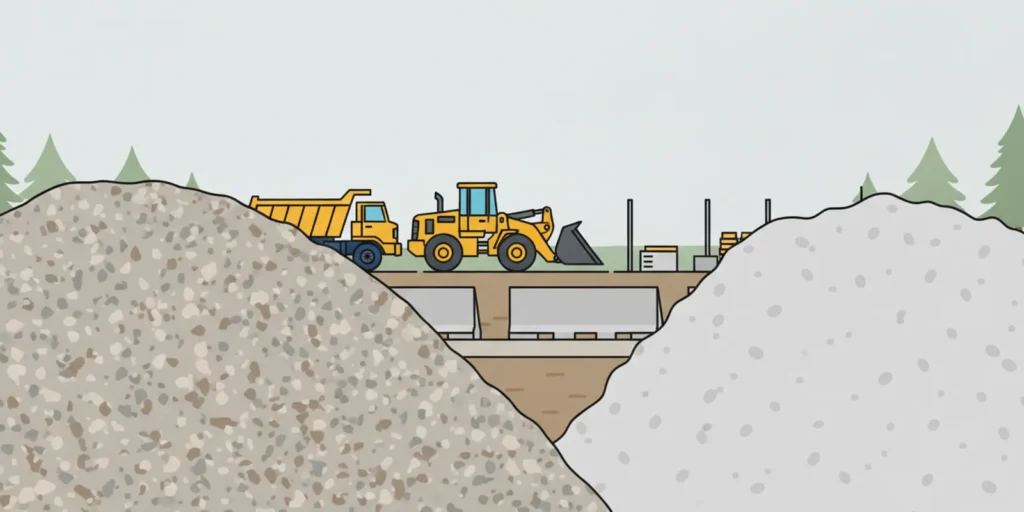
A recycled aggregate comparison is most useful when you start with the job, not a blanket claim that recycled or virgin material is always better. In Minnesota, source, gradation, drainage needs, expected loads, and placement all affect whether a material is a practical fit. This guide lays out what to compare and what to confirm before ordering.
Request project-specific material guidance
What do recycled and virgin aggregate mean?
Virgin aggregate is newly extracted material, such as crushed limestone or naturally occurring sand and gravel. Recycled aggregate is processed from previously used materials. Its properties depend on what went into it, how it was processed, and how it was screened or graded.
“Recycled aggregate” is not a single recipe. Recycled concrete aggregate comes from demolished concrete. Reclaimed asphalt pavement, often sold as asphalt millings, comes from removed asphalt pavement. Other recycled mixes may combine materials. Do not assume that one recycled product behaves like another just because both have been reused.
Likewise, “virgin” does not tell you the exact size range or suitability. The product name, specification, and intended application still matter. For example, Minnesota Aggregates describes its Class 5 material as crushed limestone. If you are considering recycled Class 5, review what the supplier identifies in the product itself; the guide to recycled Class 5 explains that material category.
How should a recycled aggregate comparison work?
Start by asking for the product source and the information available about its grading. Then relate those details to the layer you are building and the conditions it will face. The table is a screening tool, not a substitute for project specifications or supplier confirmation.
| Comparison point | Recycled aggregate | Virgin aggregate | What to verify |
|---|---|---|---|
| Source | Processed concrete, asphalt, or another reclaimed material; mixes can differ. | Newly quarried or naturally sourced stone, sand, or gravel. | Ask exactly what the product contains and whether it is a single-source or blended material. |
| Grading and consistency | Depends on feed material, crushing, screening, and processing. | Depends on deposit, crushing, screening, and product specification. | Request the available size range, specification, or gradation information for the intended use. |
| Drainage | Depends on particle sizes, fines, and how the layer is built. | Also depends on particle sizes, fines, and placement, not simply on being virgin. | Decide whether the layer should drain freely, hold together, or support another surface. |
| Compaction and placement | May vary by source and grading; follow the project specification. | Varies by product and grading as well. | Confirm lift thickness, moisture, compaction method, and required density with the project designer or supplier. |
| Load and use | Suitability depends on material properties and the application. | Suitability also depends on product properties and the application. | Match the material and layer design to traffic, equipment, and structural requirements. |
| Cost and delivery | Quote depends on product availability, quantity, distance, and site conditions. | Quote also depends on product, quantity, distance, and site conditions. | Compare delivered quotes on the same quantity, material description, and access assumptions. |
How does the material choice change by project?
For a driveway entrance or parking area, identify the intended finished surface and the supporting base separately. A recycled product or a virgin crushed aggregate may be considered for a base only if it meets the job’s requirements. The surface layer must also suit tire traffic, turning, snow clearing, and the appearance you want. Avoid ordering by a broad label alone; ask for the actual product and plan each layer.
For a drainage trench or other water-management feature, focus on the drainage design and specified stone size. A material with fines may not serve the same function as a clean, open-graded stone. The outlet and surrounding soil matter too. If the project is designed to collect or convey water, use the designer’s material requirements rather than substituting based on recycled or virgin status.
For fill or site leveling, the important questions may be the purpose of the fill, the required compaction, and whether it will support a later structure or pavement. Material that is acceptable for nonstructural shaping may not be appropriate under a slab, road, or loaded work area. Ask what testing or documentation is needed before covering the material.
For a landscape or temporary work area, requirements may differ again. Think through drainage, surface stability, cleanup, and whether the area will later be excavated. A product’s source can matter for handling and intended use, so confirm it before delivery instead of relying on a generic recycled label.
Why does the source matter?
The source gives you a first clue about what may be in the pile, but it does not replace product details. Recycled concrete can contain attached mortar and may vary depending on the original concrete and processing. Reclaimed asphalt is a different material with a different origin and intended uses. Ask whether the load is separated, blended, or screened, and whether the supplier can identify a product specification.
This distinction is especially important when a job has an engineering or municipal requirement. A project specification may permit only a defined material type or gradation. Do not substitute a general description such as “recycled base” for the named specification. Confirm approved materials with the project owner or engineer before placing an order.
Concrete applications need their own review. A Federal Highway Administration report on recycled concrete aggregate in concrete paving discusses differences in water demand and workability between recycled and virgin aggregate mixtures. That is a concrete-mixture consideration, not a universal verdict on recycled material for every base or fill application. See the FHWA review of recycled concrete aggregate in concrete paving. For Minnesota research, the MnDOT-hosted study of low and moderate recycled concrete aggregate replacement addresses concrete properties at those replacement levels. For a project using concrete, consult the required mix and design documents. Our guide to recycled aggregate for concrete covers when that material can fit around concrete work, and it is the related concrete-use resource for this comparison. A separate guide to aggregate under a concrete base covers base planning beneath a slab, which is a different question.
How do grading, drainage, and compaction change the choice?
Gradation describes the range of particle sizes in a material. A mix of sizes can help particles fit together when compacted, while a more uniformly sized product can leave different void spaces. The right arrangement depends on the layer’s purpose. A base that needs to lock together is not automatically the right choice for a drainage layer, and a drainage layer may not provide the same surface or support as a compacted base.
Ask what the material is meant to do: provide a stable base, create a finished surface, fill a low area, or move water. Then check whether the described size range and fines content align with the plan. A gravel size chart can help you understand common size descriptions, but it cannot verify the gradation of a particular load.
Drainage is a system question, not just a material question. Surface slope, soil conditions, layer thickness, edge containment, and where runoff can go all affect the result. In Minnesota, seasonal thaw and rain can expose weak drainage or poor preparation. Consider the whole profile and planned outlet instead of expecting a change of aggregate alone to solve standing water or erosion.
Compaction also depends on the material and construction method. Ask whether the project specifies a compaction target and what equipment or testing is required. Place and compact in the lifts defined by the plan rather than assuming a thicker single layer will perform the same way. If the site needs shaping or spreading, plan the equipment and labor alongside material delivery; skid steer grading and site preparation may be relevant to that part of the work.
What loads and project uses should you account for?
Consider the heaviest expected load, how often it will travel across the area, and whether turning or braking will concentrate stress. A residential walk, parking area, construction access, and road base do not necessarily call for the same layer design. For commercial or public work, follow the project specification rather than choosing by a general rule of thumb.
For a driveway or parking area, think about both the foundation and the running surface. A material that is suitable below a surface may not be the preferred final layer. The existing recycled asphalt and gravel comparison discusses a driveway-specific decision; this guide focuses more broadly on how to evaluate recycled and virgin aggregate categories. For a Class 5-specific question, see Class 2 versus Class 5. A driveway comparison of crushed concrete versus gravel stays on that surface choice and does not replace the broader comparison here.
For a concrete project, distinguish the aggregate in the concrete mix from the aggregate beneath the slab. Each has different performance requirements and may be governed by a separate specification. Do not infer that a material is acceptable for structural concrete because it is appropriate for a nonstructural base, or the reverse.
How can you compare cost without comparing unlike quotes?
There is no reliable universal rule that recycled aggregate costs less or more than virgin aggregate. Product, quantity, source availability, haul distance, order timing, and site access all affect the delivered quote. A low material price may not be the lowest total project cost if it requires extra processing, different placement, or additional hauling. Ask for comparable delivered quantities and clarify what the quote includes.
Estimate the volume before requesting a quote. Measure the area and planned depth, then convert the dimensions to cubic yards using the same units. The cubic yardage calculator is a useful planning aid. Treat the result as an estimate, since uneven ground, compaction, and final grading can change how much material the job needs.
When comparing two quotes, write down the material name, quantity, delivery location, access conditions, and any placement or spreading needs. For Class 5 planning, the Class 5 cost guide can help frame questions, but a quote should reflect your actual order. If asphalt millings are under consideration, check the asphalt millings delivery information and confirm that product matches the intended use.
How should you plan the delivery and placement?
Delivery planning is part of comparing products because a material must reach the work area and be unloaded safely. Share the delivery address and describe the route from the street to the drop point. Note narrow entrances, low branches or wires, steep approaches, soft shoulders, parked vehicles, and overhead obstructions. The available truck and unloading method may affect where a load can be placed, so confirm the drop location before the truck is dispatched.
Also decide what happens after unloading. If you will spread the material yourself, plan for equipment, access, and a workable sequence that keeps the pile from blocking traffic or drainage paths. If a contractor is placing it, coordinate the delivery window with the crew and the site preparation. Avoid assuming material delivery includes grading, spreading, or compaction; confirm what work is included in the quote.
In Minnesota, seasonal conditions can change site access and the practical order of work. Wet or thawing ground may be less able to support heavy equipment, and a delivery area can become difficult to use if the base is not ready. Check the forecast and site conditions with the project team, protect existing surfaces, and make sure water has a planned route. These steps do not determine which aggregate is best, but they help make a suitable material easier to receive and place.
What should a recycled aggregate comparison confirm before ordering?
Before you schedule, prepare a short set of details. This makes it easier to check product fit and gives the supplier the information needed for a useful quote.
- Project and layer: Explain whether the material is for base, fill, a finished surface, or another purpose.
- Material specification: Share the specified product or ask for the supplier’s description and available grading information.
- Quantity: Provide dimensions or an estimated volume, and state whether the amount is approximate.
- Loads and conditions: Describe expected traffic, equipment, soil concerns, and drainage goals.
- Site access: Note driveway width, overhead clearance, turning space, soft ground, and where a truck can unload.
- Timing: Ask about availability and the delivery window for the specific material and destination.
- Placement: Clarify whether you need delivery only or help spreading and grading the material.
Delivery timing depends on the material and order. Minnesota Aggregates states a general material delivery window of 3 to 4 business days; Class 5 orders are stated as 3 to 5 business days. Confirm the applicable window for your chosen product, location, and schedule instead of assuming every order follows the same timing. You can also review the company’s Class 5 ordering guide for product-specific planning.
Small residential jobs and larger contractor orders can both benefit from a clear delivery plan. A precise unload location and a confirmed quantity help avoid last-minute changes. For sand-related work rather than aggregate base, use the relevant sand delivery information and ensure the material fits that application.
Call to request delivery planning
Frequently asked questions
Is recycled aggregate always less expensive?
No. Delivered cost varies by material, quantity, availability, haul distance, and site conditions. Compare quotes for the same product description and delivered quantity rather than assuming recycled material will cost less.
Is recycled aggregate suitable for every base?
No single category is suitable for every base. The source, grading, design requirements, drainage plan, and expected loads all matter. Follow the project specification and verify the material before ordering.
Can recycled concrete aggregate be used in concrete?
Some concrete applications use recycled concrete aggregate, but acceptance and mixture requirements depend on the design and governing specifications. Concrete mixture performance is a distinct topic from selecting aggregate for a driveway or base. Have the engineer or mix supplier confirm the permitted material and proportions, and read the recycled aggregate for concrete guide for the concrete-use questions this comparison does not repeat.
What is the most important question to ask a supplier?
Ask what the specific product contains, what grading information is available, and whether it is intended for your project’s layer and loads. Share the specification if there is one, then confirm quantity, access, and delivery timing.
Sources and planning references
The FHWA and MnDOT-hosted references above discuss recycled concrete aggregate in concrete applications. Use them for that context, and rely on the project specification and supplier product details when comparing materials for a specific Minnesota job.
A good recycled aggregate comparison comes down to matching a known material and grading to the project’s layer, loads, and drainage plan. Confirm those details alongside quantity, access, and delivery timing before placing the order.