
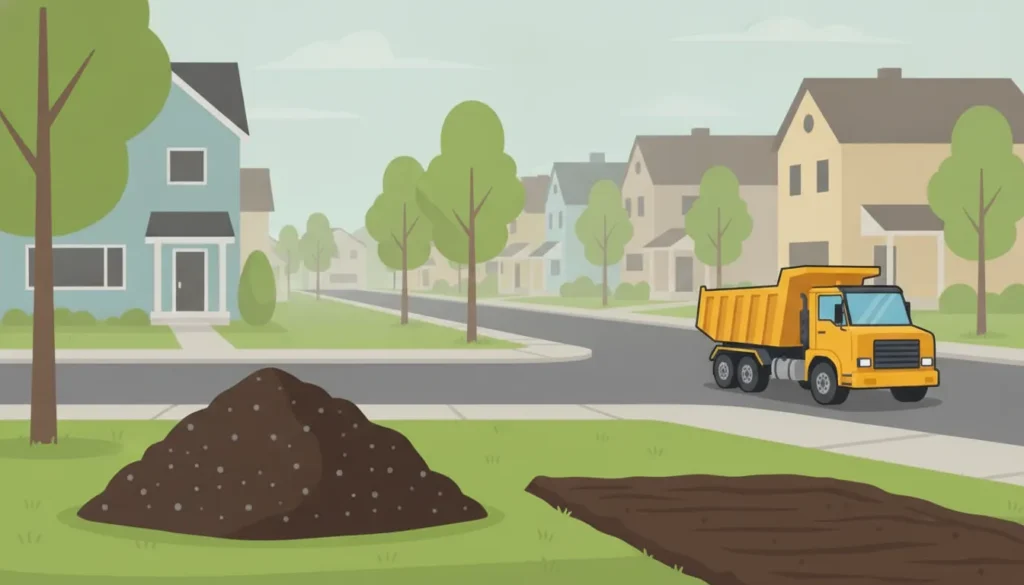
People searching screened black dirt for sale Minnesota North Metro usually need a finish layer this week, not a lesson in soil science. Screened black dirt is dark topsoil passed through a screen so rocks, sticks, and hard clumps are removed before delivery. The cleaner texture is easier to rake into a lawn, a planting bed, or a thin repair. Material is sold by the cubic yard, and Minnesota Aggregates delivers it with no minimum order. A useful order names the city, the yardage, the depth, and where the truck can dump.
Request a screened black dirt quote or call (612) 772-3677.
Where to find screened black dirt for sale Minnesota North Metro
Buyers in Blaine, Coon Rapids, Andover, Anoka, Ramsey, and Elk River usually need material they can spread the same week. Minnesota Aggregates covers that North Metro territory. The company will also quote delivery farther into the Twin Cities or elsewhere in Minnesota. The sale is a delivered load, not a bag from a store shelf.
A homeowner fixing a side yard and a landscaper topping a new lawn are buying the same product for different reasons. One cares that a small truck can reach a gate. The other cares that a second load can arrive before seed goes down. Both still need the screened product named on the quote, because a generic dirt order is easy to misread.
Screened and non-screened black dirt are both available. Screened material is the cleaner finish product. Non-screened black dirt is the more economical bulk option when the look of the surface matters less. The black dirt delivery page is the place to start an order. This guide is the planning step before that call.
Ask for screened black dirt by name if the load will sit near the surface. A quote that only says “dirt” can mean fill, non-screened soil, or a finish product. Those are different jobs. Name the city too. Distance from the source changes both the schedule and the quote.
North Metro work often sits on small residential lots rather than open fields. A load that looks modest on paper can still block a driveway in Fridley or a shared court in Coon Rapids. Buying the right product includes buying the right amount for the space you have to store it until it is spread.
What screened black dirt is good for
Screening does not turn ordinary soil into a lab-tested planting blend. It removes the debris that makes spreading slow and leaves the surface lumpy. Use screened material where people will see and walk on the finished layer.
- New lawn areas and thin lawn repairs, once the ground underneath is already shaped.
- Garden beds and flower beds that need a dark, workable surface.
- Shallow low spots, after you know the low spot is not a drainage problem.
- A finish layer over fill once the bulk of the grade is already built.
It is a poor choice as the only material when you must raise a yard by a foot or support a driveway. Those jobs need a planned fill or base first. Read what screened dirt means if you want the processing term. Use fill dirt versus black dirt when you are still choosing the layer. Do not treat a dark color as proof of nutrients. If a planting plan calls for a soil test, get one before a large lawn or garden order.
Think of screened black dirt as the last layer people touch. Seed, sod, and mulch go on top of it. Gravel, fill, and base courses belong underneath, where looks matter less than strength. Mixing those layers in one order is how a finish project turns into a redo after the first rain.
How much screened black dirt for sale Minnesota North Metro should you order?
Order by volume rather than by truck size. Measure length and width in feet, choose a depth in feet, and divide by 27 to get cubic yards. A 30-by-40-foot area covered 3 inches deep, which is 0.25 foot, equals 300 cubic feet, or about 11 cubic yards. The same area at 4 inches is about 15 cubic yards.
| Area | 3-inch finish | 4-inch finish. |
|---|---|---|
| 10 by 20 feet | About 2 cubic yards | About 2.5 cubic yards. |
| 20 by 30 feet | About 6 cubic yards | About 7.5 cubic yards. |
| 30 by 40 feet | About 11 cubic yards | About 15 cubic yards. |
| 50 by 50 feet | About 23 cubic yards | About 31 cubic yards. |
Split an odd yard into rectangles and add the pieces. A curved bed or a narrow side yard is easier that way than as one average. The cubic yardage calculator does the same math and suggests adding 5 to 10 percent when you expect compaction or a little extra grade work. Sand barely settles. A finish soil can settle more once it is raked and watered, so a small extra is normal. It is not a reason to double the order.
Three inches is a common finish over ground that is already close to grade. Four inches is a fuller top for a new lawn area if the plan calls for it. Deeper than that, stop and ask whether you are buying finish soil to do a fill job. Trucks in the Minnesota Aggregates fleet carry about 3 to 22 cubic yards. A small repair can ride on a smaller truck. A full yard often needs one large load or more than one trip.
Round up only when the shape is uneven or you expect to lose a little soil into grass at the edges. Round down if you still have to confirm a property line or a bed outline. Extra soil is not free to move once it is on the ground. A second small load is often easier than a pile that sits in the driveway for a month.
Write the measurement down before you call. “About a dump truck” is not a quantity. Ten cubic yards and twenty cubic yards are both common, and they are not close once you are paying for hauling. If two people on the job disagree, measure again rather than splitting the difference.
How North Metro yards change the delivery
Older lots in Anoka, Fridley, and parts of Coon Rapids often have short driveways, fences, and mature trees. Newer streets in Blaine, Andover, and Ramsey may have more room, but soft new lawns and fresh boulevards are easy to rut. The truck needs firm ground, room to turn, and a clear path with no low wires or tight gates.
Mark the dump spot before the driver arrives. A pile on the driveway is simple to reach and hard on the concrete if you leave it wet for days. A pile on the lawn is closer to the work and can sink if the ground is soft. Spring thaw and a wet week are the usual reasons a spot that looked fine on Saturday fails on Tuesday.
Say which side of the house the truck may use, and whether it must back in. If the only path crosses a septic area, a neighbor’s lawn, or a steep boulevard, say that in the quote request. The driver can often place the pile where you ask. The driver cannot invent access that is not there.
Boulevards in many North Metro cities are city right-of-way, not spare storage. A pile left on the curb can block mail, plows, or a neighbor’s sight line. If the driveway is the only firm spot, plan to move the soil within a few days so daily parking still works. Tell the dispatcher if a school bus, alley, or cul-de-sac makes a long truck a problem.
General material delivery is typically scheduled within 3 to 4 business days. Rush timing is sometimes available. Ask when you request the quote, and do not assume a same-day load. In the busy months, booking about a week ahead is the safer plan. Winter delivery depends on weather and whether the site can take a loaded truck.
What to send with a quote request
A short note gets a useful number. A vague “some black dirt” note gets a follow-up call. Include these items:
- The city and the street address, so distance and access can be judged.
- Screened black dirt, not just “dirt” or “fill.”
- The cubic yards you calculated, plus the area and depth behind that number.
- What the layer is for: lawn finish, beds, low spots, or a cap over fill.
- Where the truck can dump, and any gate, wire, or soft-ground limit.
- Whether you also want the pile spread, and the day you hope to receive it.
Pricing is quoted from yardage, distance, and site access. There is no single shelf price, and there is no minimum order. A 3-yard repair and a 20-yard yard are both real jobs. They are not the same trip. If you want a cost frame before you call, read topsoil delivery cost per ton for the factors that move a quote. Do not treat a published industry range as this company’s price.
When the pile should be spread for you
A dumped load still has to be moved. A wheelbarrow and a rake are enough for a small bed. They are a long day on an 11-yard lawn. Minnesota Aggregates can pair the delivery with skid steer work to spread black dirt, fill low spots, and do light grading. That service is quoted from the scope, the site, and travel time.
Ask for spreading when the pile is large, the grade has to slope away from the house, or you do not want equipment rented for one afternoon. See skid steer services for the kind of work an operator can do in a tight yard. If the whole yard needs to be reshaped before any topsoil goes down, start with dirt grading and leveling instead of burying a grade problem under screened soil.
Keep the two quotes separate in your notes even if they happen on the same visit. One is material. One is machine time. Mixing them makes it hard to compare a later change in yardage.
Spreading is worth it when the finished surface has to slope away from a foundation or a patio. A rake can smooth a bed. It cannot reliably set a long slope across a front lawn. If you only need the pile moved ten feet closer to the beds, say that. A shorter move is a different job from grading the whole yard.
Checks before you place the order
Walk the area with a tape and a hose or string so the depth is real, not a guess from the curb. Look at the soil you already have. If water sits for days, more black dirt on top will not fix the pitch. Shape the grade first, or ask for that work in the same conversation.
The USDA Natural Resources Conservation Service Web Soil Survey shows mapped soil for most U.S. counties, including the North Metro. It is a planning map, not a test of the load on the truck. Use it to see whether your lot is sandy, heavy, or poorly drained. Then match the screened black dirt to the layer you are actually building. A soil test is still the right tool if a lawn or garden plan depends on nutrients.
Confirm five things before you say yes. The product is screened black dirt. The yards match your measurement. The dump spot is firm. The date fits the 3 to 4 business day window, or an agreed rush. You know whether spreading is included. For other materials on the same North Metro job, the North Metro landscaping delivery guide covers the wider order. Keep this page for the screened soil itself.
If the project is only a few bags worth of soil, a delivered bulk load may be more than you want to store. Most North Metro buyers who search for this material are past that point. They have a lawn section, a new bed, or a low spot that is measured in yards, not bags. Match the order to that size and you will not be left with a pile you cannot use.
Request a screened black dirt quote or call (612) 772-3677.
Frequently asked questions
Is screened black dirt the same as fill dirt?
No. Screened black dirt is a darker topsoil with the larger debris removed, meant for a finish layer. Fill dirt is for building grade. Use fill to raise an area, then cap it with screened soil if you need a lawn or a bed.
How many cubic yards are in a small North Metro delivery?
Loads can start around 3 cubic yards and run up to about 22 cubic yards on one truck. There is no minimum order. Measure the area and the depth, then send that yardage with your city so the truck size can match the job.
Can I buy screened black dirt for a lawn in Blaine or Anoka?
Yes. Blaine, Anoka, Coon Rapids, Andover, Ramsey, and Elk River are in the North Metro delivery area. Tell the quote desk the city, the yards, and whether the truck must back into a short driveway or a fenced yard.
How soon can screened black dirt be delivered?
General material delivery is typically scheduled within 3 to 4 business days. Ask about rush timing when you request the quote. In busy months, or after a wet spring week, plan on about a week so access and the calendar both work.
Does screening mean the soil is ready for a vegetable garden?
Screening makes the soil easier to spread. It does not set a nutrient level or a pH. For a vegetable bed, use screened black dirt as the bulk of the surface if it fits the plan. Then follow a soil test before you rely on it for a full food crop.