
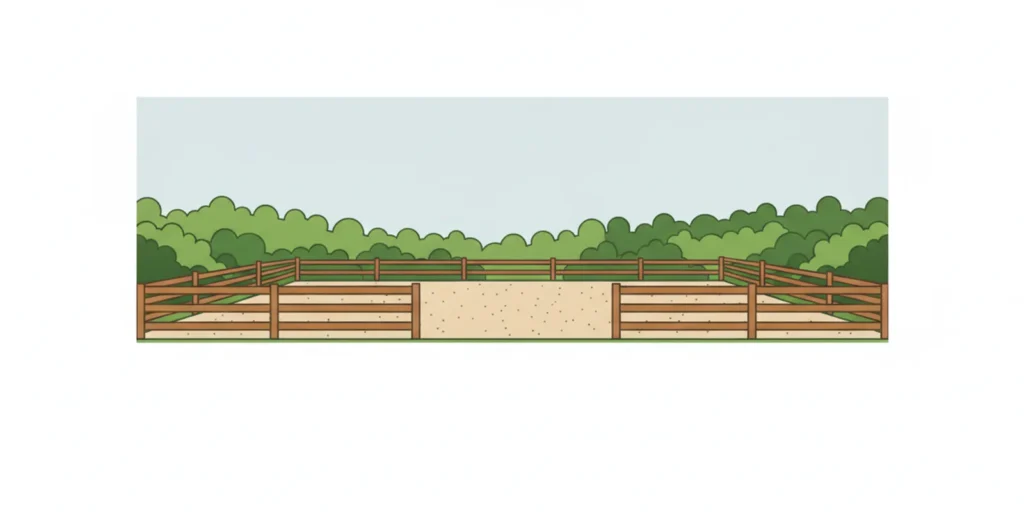
Choosing horse arena footing is not just a matter of finding sand that looks fine and clean. The surface has to work with the arena’s base, drainage, intended riding activities, maintenance routine, and local weather. Those details affect how a material behaves after installation and through repeated use. This guide explains what to plan and what to ask before ordering sand for a Minnesota arena. It is material-planning information, not an arena design specification.
Ask about sand availability and delivery
What should horse arena footing do?
A riding surface needs to provide predictable contact for horse and rider. In practical terms, arena footing should be considered as a system: the prepared ground, any base layers, drainage, and the riding surface all influence the result. A surface material cannot correct every problem below it. For example, water that cannot leave the arena may affect usability even if the top layer was selected carefully.
There is no single sand or blend that is right for every arena. The appropriate surface can depend on how the arena will be used, how often it will be ridden, local conditions, maintenance equipment, and the design beneath it. A private arena used occasionally may have different demands from a frequently used training or competition space. Ask an equestrian arena professional to assess design and performance needs before treating a material choice as settled.
Professional arena testing and evaluation can provide useful context for surface decisions. The University of Kentucky’s discussion of evaluating arena footing is one reference for why assessment should consider the surface as a working system, not only its appearance.
How do sand characteristics affect the surface?
Sand is a major component in many riding surfaces, but the word “sand” alone does not describe how a delivered material will perform. Grain size distribution, particle shape, cleanliness, and the range of particle sizes can influence how material packs, shifts, retains moisture, or drains. The arena’s base and watering and grooming practices also matter. These are evaluation factors, not a promise that a particular material will produce a particular ride.
When discussing available sand, ask for information about the material itself rather than relying on a product name or a photograph. Ask what screening or processing is used, what range of particle sizes is typical, whether the material has been washed, and what variability to expect between loads. A supplier may be able to explain material characteristics, while an arena designer or footing specialist should advise whether those characteristics suit the planned surface.
Minnesota Aggregates lists clean, screened sand among its materials. That description does not by itself establish suitability for horse arena footing. Before ordering, share your intended application and confirm whether the available material meets requirements set by your arena professional. You can review the company’s information about screened sand delivery in Minnesota and its broader sand delivery options, then verify the specific product details directly.
Why should drainage be planned before selecting a surface?
Drainage affects how an arena handles rain, snowmelt, watering, and repeated use. Water may need to move across the surface, through some layers, or away from the arena perimeter, depending on the site and construction. The right approach depends on the soil, slope, water outlet, base design, and local conditions. A surface layer alone cannot guarantee drainage if water is trapped below it or has nowhere to go.
Start by looking at the site after wet weather. Note where water collects, whether runoff approaches the arena from surrounding ground, and whether the area has a clear route for water to leave. Existing low spots, soft areas, and persistent wet patches are useful observations to share with the arena professional. Do not assume that adding more sand will resolve a drainage issue; extra material could change elevations without correcting the cause.
Ask the person responsible for design to explain the intended drainage path and how the layers work together. Confirm who is responsible for grading, the base, drainage features, and final surface. If site preparation or grading is part of the project, describe the scope clearly and consult a qualified professional. Minnesota Aggregates provides information about its skid steer services; the page can help you understand that service, but it is not a substitute for arena design or drainage advice.
How should you think about footing depth?
There is no universal depth to order for every arena. The amount of surface material depends on the design, the existing base, the intended riding disciplines, the material characteristics, and how the surface will be maintained. A depth that works in one arena may not work in another. Do not use a general online number as a specification without having the whole section reviewed.
Before estimating quantity, have the arena’s finished dimensions and target surface depth confirmed by the person designing or managing the footing. Clarify whether the depth refers to loose material when delivered, after it is spread, or after it has been worked and settled. Also ask whether the calculation includes the full arena footprint or accounts for edges, transitions, and any areas that should not receive the riding surface.
Once the design professional gives you an area and volume, a cubic yardage calculator can help convert the measurements into a planning estimate. Treat the result as an estimate to review before ordering. Confirm the unit used by the supplier, the delivered quantity, and whether the delivery vehicle can place material where it is needed. For a broader overview of purchasing in bulk, see this bulk sand delivery buyer’s guide.
What can change how the surface behaves?
Surface behavior reflects several interacting variables. A material that seems firm on one day may feel different after watering, grooming, heavy use, or a change in weather. A loose or deep-feeling surface, uneven areas, dust, or persistent wetness may point to a need for review, but one observation does not identify the cause. The surface, its moisture condition, the base, and maintenance practices all deserve consideration.
Use this comparison to organize questions. It is not a ranking of products or a substitute for testing and professional recommendations.
| Planning factor | What to clarify | Why it matters |
|---|---|---|
| Intended use | Riding activities, frequency, and expected traffic | Use influences the performance requirements to discuss with an arena professional. |
| Sand characteristics | Available particle information, processing, and load consistency | “Sand” is a broad label; details help the designer evaluate a candidate material. |
| Drainage and base | Existing site conditions, planned layers, and water outlet | The finished surface depends on more than the top layer. |
| Depth and quantity | Specified finished depth, footprint, and estimating units | A confirmed design reduces the risk of ordering too little or too much. |
| Maintenance | Watering, grooming, and routine upkeep plan | Management affects how the surface changes with use and weather. |
| Delivery access | Truck route, unloading area, and placement instructions | A workable delivery plan helps get material to the intended staging location. |
How can you compare candidate materials fairly?
Use the same questions for every candidate so the comparison is about useful details, not labels alone. First, write down the material description each supplier uses and request any available information about its processing and particle characteristics. Share those details with the arena professional, who can say whether the candidate is worth further consideration. If a supplier cannot verify a particular property, record that as unknown rather than assuming the material meets a requirement.
Next, compare practical ordering terms. Confirm how the quantity is measured, what the quote includes, where the truck can unload, and what delivery window is being discussed. Keep delivery and placement separate: a delivered load may still need to be moved, spread, and finished by others. Clarify who will perform that work and whether the site must be prepared before the truck arrives. These questions help reveal whether two quotes describe comparable materials and services.
Finally, let the design professional make the technical decision. A supplier can explain available products and delivery logistics; that conversation should not replace an evaluation of the arena’s intended use, site, and full construction section. If the professional recommends a particular specification, ask how the proposed material information aligns with it and whether any additional testing or documentation is appropriate. Keep the written recommendation with the order details so the material received can be checked against the plan.
How do Minnesota seasons affect planning?
Minnesota weather makes it important to plan around site conditions and the construction schedule. Rain, freeze-thaw cycles, snowmelt, and seasonal ground conditions can affect when site work is practical and how water moves around an arena. The timing and effect vary by site, so plan with the contractor responsible for the work rather than assuming a calendar date guarantees suitable conditions.
Include delivery lead time in the schedule. General material deliveries are typically stated as 3–4 business days, but availability and timing should be confirmed for the requested material, quantity, location, and conditions. If the order is for a narrow construction window, ask about scheduling early and make sure the site will be ready to receive the load. The company’s guide to buying sand in bulk can help frame ordering questions, but your project schedule should be confirmed directly.
Prepare access details before delivery: gate width, overhead clearance, turning space, ground firmness, unloading location, and any restrictions on truck movement. Identify whether a staging area is available and how material will be moved from that point into the arena. Do not assume a delivery truck can enter the riding area or travel across a finished surface. Confirm placement instructions with the supplier and site contractor in advance.
What should you ask before ordering sand?
A clear conversation separates material supply questions from arena design decisions. Share the project location, estimated quantity, requested delivery window, access conditions, and the application. Then ask practical questions such as:
- What sand materials are currently available, and how are they described?
- Can you provide information about screening, particle size range, or other relevant material characteristics?
- Does the material vary between loads, and how can I confirm the specific material before ordering?
- What quantity units are used for the quote and delivery? How should I convert the design professional’s volume estimate?
- What delivery truck sizes or placement options may be available for the site?
- How far ahead should I schedule, and what conditions could affect the delivery date?
- What site access and unloading details do you need before dispatch?
- Can the arena professional review the material information before I commit to an order?
For a quote, provide consistent project details and distinguish the quantity estimate from the final design specification. If you are comparing suppliers, compare the described material, quantity basis, delivery details, and schedule—not just the product label. Minnesota Aggregates has additional information on buying sand by the bulk and mason sand delivery; neither label should be treated as an arena recommendation without review by your footing professional.
What should you confirm before the material arrives?
Before confirming a load, match the order to the project plan. Check the material description against what the designer or footing specialist reviewed. Recheck the quantity and units, the delivery address, access route, unloading location, and any site preparation that must be complete first. Agree on who will inspect the delivered material and who will direct spreading and finishing.
It can help to keep a simple record of the order: material description, date, quantity, supplier information, and any available load documentation. If the received material appears different from what you expected, raise the question before it is spread. That is easier than trying to diagnose a surface issue after installation.
After installation, follow the maintenance instructions from the person responsible for the arena surface. Avoid changing watering, grooming, or adding materials based only on a general tip. If the footing’s feel or condition changes, document when and where the change occurs and ask a qualified arena professional to assess it.
Call to discuss sand availability and delivery
Frequently asked questions
Can any screened sand be used for horse arena footing?
No. “Screened” describes processing but does not establish that the material meets the needs of a particular arena. Ask for material details and have the arena professional evaluate them against the design and intended use.
How deep should horse arena footing be?
There is no single depth that fits every arena. Confirm the depth with the professional responsible for the arena design, and clarify whether the figure refers to the finished, loose, or settled surface before estimating quantity.
Does sand alone solve arena drainage problems?
Not necessarily. Drainage depends on the site, grading, base layers, and where water can go. Have the cause of standing water or soft spots assessed before adding or replacing surface material.
How far ahead should I order sand?
Ask the supplier to confirm availability and delivery timing for your material, quantity, location, and requested date. General material delivery is typically 3–4 business days, but timing can vary, so leave room in the project schedule and confirm before relying on a date.
Can I calculate arena sand quantity from the arena dimensions?
Dimensions are a starting point, but you also need a confirmed finished depth and a clear understanding of how the volume will be measured. Have the design professional confirm those inputs, then use a calculator for an estimate and verify the order units with the supplier.
Sources and planning references
The FEI Standard for Arena Surfaces describes consistency and performance in relation to use and weather. The University of Kentucky’s arena footing evaluation reference discusses testing and evaluating surfaces. Consult an equestrian arena professional for recommendations specific to your site and intended use.
Planning the material conversation in advance can help you compare available sand, understand the delivery requirements, and coordinate the order with the arena’s design and construction plan.